Rising Voice from New Delhi: BRICS's New World Order Manifesto
Umur Tugay Yücel 11.06.2026 18:01Author
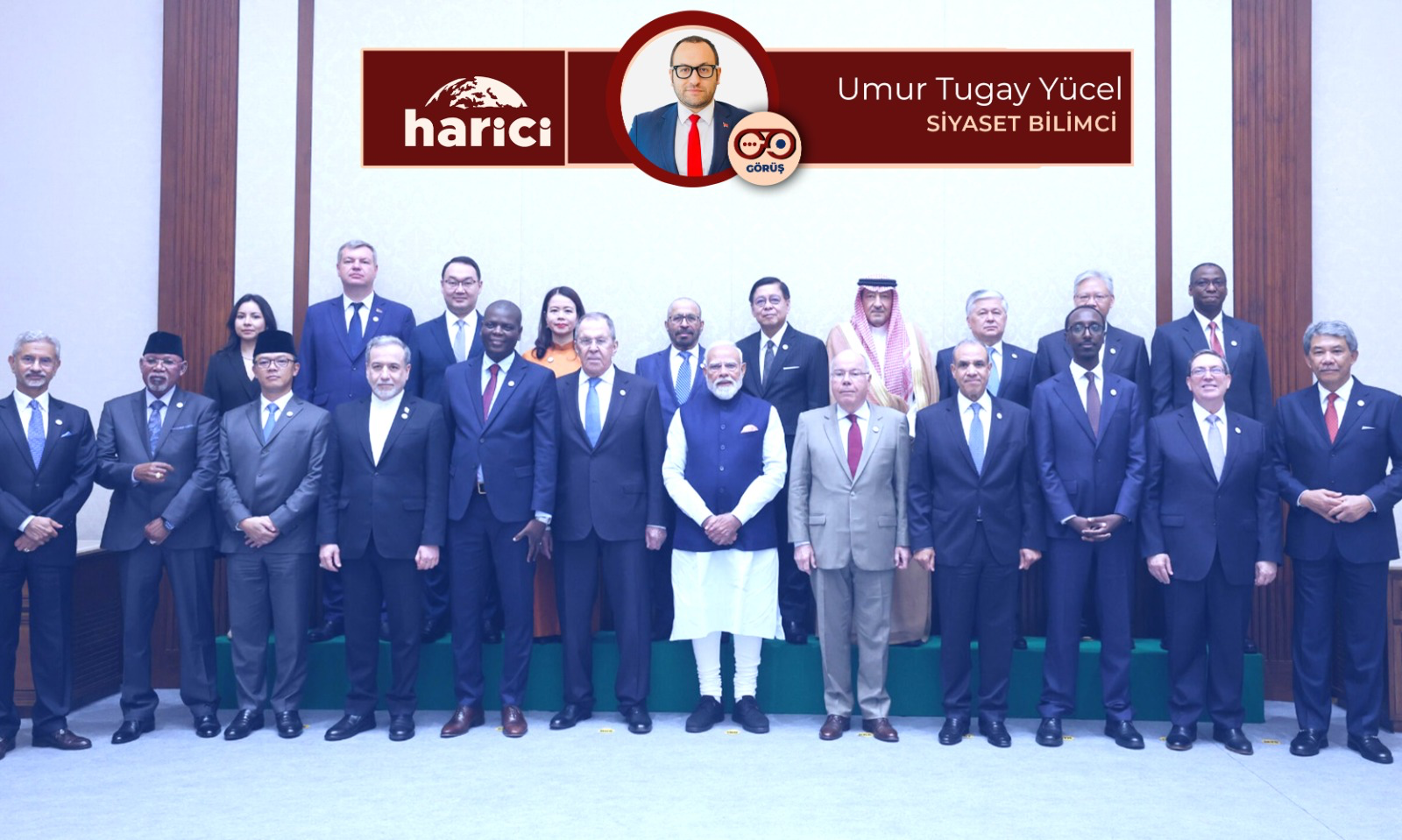
The BRICS Foreign Ministers' Meeting, which was held in New Delhi, the capital of India, on May 15, 2026, has a meaning far beyond being an ordinary diplomatic meeting. At this meeting, one of the most comprehensive political documents showing what kind of world order BRICS envisiged in 2026 was signed. Looking between the lines of the document, in addition to being just a meeting of foreign ministers, the outline of a comprehensive alternative vision for the current Western-based international system is also revealed. This document should actually be read as one of the political manifestos of the changing balances and the rising new world order of the global power struggle that has accelerated in recent years.
The main theme that dominates the entire document is "The Rise of the Global South". BRICS members argue that the current international order is not fair, not representative enough, and does not reflect the interests of developing countries. For this reason, they emphasize that institutions such as the UN, IMF, World Bank, World Trade Organization (WTO) should be restructured. Thus, BRICS now positions itself as the spokesperson of the world outside the West. Today, the world is going through a period when the international system established after the Second World War is dragged into a serious crisis of legitimacy and representation. Developments such as the Ukrainian war, the Iranian war, the Lebanon war, the Gaza crisis, global trade wars, the transformation of sanctions into weapons, energy security problems and technological competition reveal that the current system is now difficult to reflect global realities. BRICS countries are moving from this point and send a clear message to the world with the New Delhi Outcome Document: “The current order is no longer sustainable.”
One of the most remarkable aspects of the document is that it makes it clear that BRICS no longer sees itself as just an economic collaboration platform. BRICS, which has been focussing on economic development, trade and finance for a long time since its establishment, has reached a much more ambitious point today. Security, geopolitical crises, artificial intelligence, cybersecurity, climate policies, energy transformation and international governance reforms take a central place as well as the economy in the New Delhi Conclusion Document. This shows that BRICS' goal of becoming a founding actor in global politics is getting stronger. Looking between the lines of the document, the strongest emphasis is in the concept of "multipolar world". The idea that the international order, which was Western-centered and largely American-led for almost two decades after the end of the Cold War, is no longer the only option, is the basic approach of BRICS. The phrases of the "fairer", "more representative", "more democratic" and "more inclusive" international system, which are repeatedly used throughout the declaration, are actually a direct criticism of the current global power distribution.
Especially the sections related to United Nations Security Council reform are extremely important. One of the most critical political parts of the document is the call for UN reform. BRICS countries clearly state that the current structure does not reflect the realities of today. They argue that Africa, Latin America and rising Asian powers are not adequately represented in decision-making mechanisms. What is even more remarkable is that China and Russia have re-explained their support for India and Brazil to take a greater role in the Security Council. This situation primarily shows us that India and Brazil have risen to global power status. Then it proves that political harmony within BRICS has increased. Finally, II. We see that the order established after the World War is questioned.
Another prominent element in the document is harsh criticism of the sanctions policies of the USA and the West. In recent years, the intensive use of economic sanctions as a foreign policy tool has created a common inconvenience in BRICS countries. In the text, it is emphasized that unilateral sanctions are against international law and especially affect the economic development of developing countries negatively. Although this statement is not named directly, it can be read as a strong criticism of practices such as US sanctions against Iran, Russian sanctions, Venezuela sanctions, Cuban embargo. This approach is a continuation of the criticism of "armament of the economy" that BRICS has long expressed. In fact, one of the most strategic sections of the report emerges here. Because BRICS no longer just criticizes the current financial system. It is also trying to develop alternative mechanisms. Headings such as cross-border payment systems, trade with local currencies, financial integration and strengthening the New Development Bank can be read as signs of a search for a long-term alternative to the dollar-centered global economic structure. It is not yet possible to talk about a system that can replace the dollar. However, the steps taken by BRICS are starting to show that the current financial order is not the only option.
Again, one of the important political parts of the New Delhi Document is the issue of Gaza and Palestine. We are witnessing one of the strongest BRICS stances on Gaza. The document contains very harsh statements about Gaza and Palestine. The emphasis on the independent Palestinian state on the basis of 1967 borders draws attention. In addition, the lawsuit filed by South Africa against Israel and the decisions of the International Court of Justice are directly recalled in the document. BRICS countries have shown one of the clearest common stances so far in the face of recent attacks and humanitarian crisis. The demand for a ceasefire, the demand for the unhindered delivery of humanitarian aid, the support of the Palestinian state and the emphasis on international law are among the strongest political messages of the statement. This situation can also be considered as an indicator of BRICS' desire to be a more visible and more effective political actor in global crises.
On the other hand, the text does not completely hide the differences within BRICS. It is clearly stated that there are different views among the members, especially on the Middle East. This is important because today BRICS is not a structure consisting only of Brazil, Russia, India, China and South Africa. With new members such as Iran, the United Arab Emirates, Egypt, Ethiopia and Indonesia, it has become a much more complex geopolitical structure. Interestingly, it is clearly stated in the document that there are different opinions instead of a common attitude on some issues. It has been accepted that the members have different positions, especially in issues such as Iran, Gulf countries and Yemen. Despite this, the fact that the union can create a common ground shows that the diplomatic capacity of BRICS has increased. From this point of view, the New Delhi process also represents an important diplomatic achievement of India. With the latest wave of enlargement of BRICS, the accession of new members such as Iran, the United Arab Emirates, Egypt, Ethiopia and Indonesia to the union has increased the geopolitical diversity of the platform on the one hand and complicated the joint decision-making processes. Due to the deep differences of opinion between Iran and the Gulf countries, especially during a period of the Iran war, many experts predicted that BRICS would have difficulty in creating a common political ground and that the meeting would be the scene of serious diplomatic tensions. However, despite all these differences, India has managed to bring together members whose interests and priorities are separated around the same platform, showing that BRICS maintains its capacity to produce dialogue instead of fragmenting. In this context, the result in New Delhi is not limited to the content of the published common text. The remarkable success is that the diplomatic ground has been preserved that allows members who are directly confronted on some issues in an environment of extremely sensitive and polarizing crisis to continue to negotiate under the umbrella of BRICS by agreeing on other issues.
In addition, one of the most important messages of the document is in the field of technology. It is no coincidence that topics such as artificial intelligence, digital infrastructures, data security and cyber security are widely addressed. Because the global power struggle of the future will also be shaped by technological superiority. BRICS countries make it clear that they are aware of this fact and want to act together in the technology race. Especially in terms of artificial intelligence governance, the search for alternatives to Western-centered norms draws attention. It seems that BRICS has developed a different approach to energy and climate policies. Instead of rapid energy transformation, which is often emphasized by Western countries, the concept of "fair energy transformation" is highlighted. The basis of this approach is the idea that the economic growth needs of developing countries should not be ignored. BRICS countries advocate establishing a balance between environmental responsibility and the right to development. This points to an important area of separation that will become more prominent in the coming years in global climate debates.
When all these topics are evaluated together, the picture that emerges is quite clear. BRICS is no longer just a platform where economic interests are protected. BRICS is a powerhouse that is starting to create its own vision of how the international system should work. The basis of this vision is the goal of more representation, more sovereign equality, more multipolarity and the goal of developing countries to have more say in their global decision-making processes.
The New Delhi Document, which was put on the table at the BRICS Foreign Ministers' Meeting, is one of the important documents of the historical transformation in global politics rather than a meeting result text. While the world is rapidly moving away from the single-centered structure, BRICS is becoming one of the most powerful political and economic carriers of this transformation. Today, many rules of the international system may still be determined by the West. However, the rising message from New Delhi is this: Many more actors now want to take part in the table for those rules to be rewritten. BRICS is no longer an economic club. This structure is turning into a political, diplomatic, financial and technological power center. The claim to be the common voice and compass of the Global South is getting stronger. A strategy that is both an alternative to Western-based institutions and tries to transform them is being followed. BRICS has not yet established institutions to replace the UN, IMF, World Bank or WTO. However, it is trying to change the rules of these institutions and the distribution of power.
President India's Foreign Ministers' Meeting 2026 New Delhi Document can be considered one of the most comprehensive strategic documents in the 20-year history of BRICS. The text is a political manifesto of a period in which the unipolar period led by the USA and the West has come to an end, the rising powers want to have more say, and the Global South's quest to build a permanent weight in the international system has accelerated.
The essence of the document can be summarized in a single sentence: BRICS is a platform that adapts to the rules of the current international order, but it is becoming a global actor who wants to rewrite these rules.
Umur Tugay Yücel-Politics Scientist – is the author of the book “The Regression of American Power and Rising Powers” (China-Russia-India-Brazil).
X: @umur_tugay
Rising Voice from New Delhi: BRICS's New World Order Manifesto